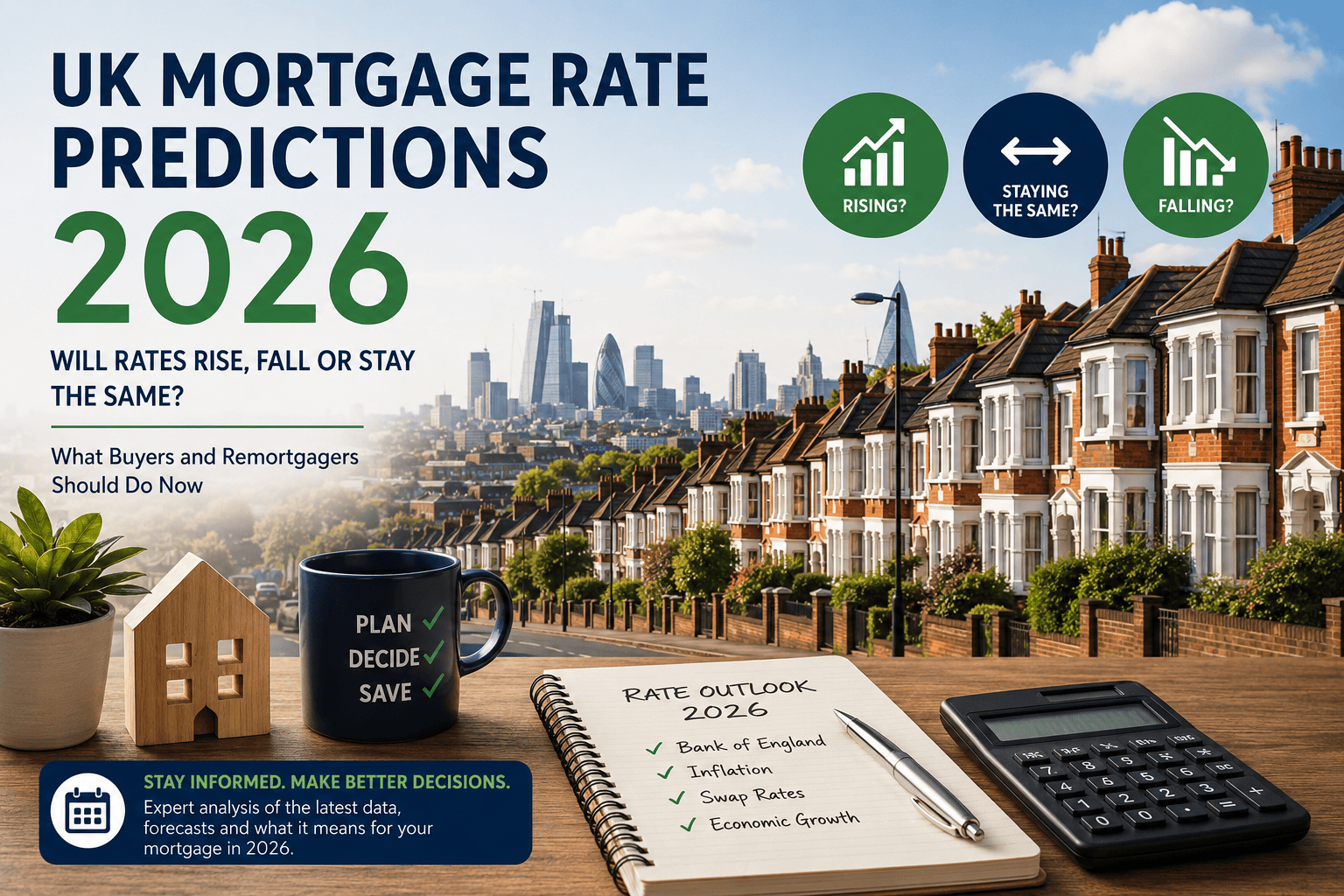
Will UK Mortgage Rates Rise or Fall in 2026? What Buyers and Remortgagers Should Do Now
Last reviewed: 5 August 2026
Mortgage rates remain one of the biggest concerns for UK homebuyers and homeowners in 2026. After several years of sharp rate changes, borrowers are asking whether mortgage costs will fall, whether another increase is possible, and whether they should secure a fixed deal now or wait.
There is no reliable way to predict the exact mortgage rates lenders will offer several months from now. Current economic conditions do, however, give borrowers useful clues.
The Bank of England held Bank Rate at 3.75% on 30 July 2026. UK CPI inflation had fallen to 2.6% in June, but remained above the Bank's 2% target. This means borrowers should not assume mortgage rates will fall steadily during the rest of 2026. Selected lender deals may improve, but fixed rates could also rise if inflation expectations or wholesale funding costs worsen.
The 2026 Mortgage Rate Outlook at a Glance
As at 5 August 2026:
- Bank Rate is 3.75%.
- The Bank of England voted by six members to three to hold the rate at its July meeting.
- CPI inflation was 2.6% in the 12 months to June 2026.
- The effective interest rate actually paid on newly drawn mortgages was 4.35% in June 2026.
- The next Bank of England decision is scheduled for September 2026.
The effective rate is an average across newly completed mortgages. It is not the same as the best advertised mortgage rate. Your available rate will depend on factors including deposit size, loan-to-value, mortgage type, income, credit profile, property and lender criteria.
Current official sources: Bank of England July 2026 decision, ONS June 2026 inflation data and Bank of England June 2026 mortgage data.
Will UK Mortgage Rates Go Down in 2026?
Mortgage rates could fall if inflation continues moving towards the Bank of England's target and financial markets become more confident that Bank Rate can be reduced. A fall is not guaranteed.
The July vote shows that inflation risks remain under discussion. Six Monetary Policy Committee members voted to keep Bank Rate at 3.75%, while three preferred an increase of 0.25 percentage points. Borrowers should therefore treat confident predictions of a rapid series of rate reductions with caution.
Our view is that mortgage pricing is more likely to remain changeable than follow a smooth downward path. Lenders may reduce selected products when funding conditions improve or when they want to attract more business. They may also withdraw or reprice products quickly if market costs rise.
Why Mortgage Rates Can Change When Bank Rate Stays the Same
Swap rates and wholesale funding
Fixed mortgage rates are influenced by financial-market expectations for future interest rates. If markets expect rates or inflation to remain higher, lender funding costs can rise before the Bank of England makes another decision.
Inflation
Persistent inflation makes interest-rate reductions less likely. CPI inflation had fallen to 2.6% by June 2026, but it remained above the 2% target. Services inflation, wage growth and energy costs can all affect the Bank's assessment.
Lender competition
Lenders do not all change their rates at the same time. A bank or building society may introduce a competitive product to meet lending targets or attract borrowers within a particular loan-to-value band.
Loan-to-value ratio
Loan-to-value, usually shortened to LTV, compares the mortgage with the property's value. A lower LTV can provide access to a wider choice of products and may lead to a lower rate.
Fees and incentives
The lowest interest rate is not always the cheapest mortgage overall. Arrangement fees, valuation costs, legal work, cashback and early repayment charges all need to be considered.
Three Possible Mortgage-Rate Scenarios for the Rest of 2026
Rates ease gradually
Mortgage rates may fall if inflation remains controlled, energy prices settle and markets expect a future Bank Rate reduction. Competition between lenders could also improve selected fixed deals.
Rates remain broadly stable
Rates may move within a relatively narrow range if inflation remains above target but does not worsen enough to require tighter policy. Individual lender changes may matter more than a broad market movement.
Rates rise again
Fixed mortgage rates could increase if inflation expectations, energy costs or wholesale funding costs rise. Bank Rate could also increase if the Monetary Policy Committee believes inflation is becoming persistent.
Reviewing Your Mortgage in 2026?
Tell us when your current deal ends or what you are planning to buy, and we will explain the next steps.
Should I Fix My Mortgage Now or Wait?
There is no single answer that suits every borrower. The decision should reflect your finances, mortgage timing and tolerance for changing monthly payments.
Securing a fixed mortgage may be suitable when:
- You need predictable monthly payments.
- Your current fixed deal ends within six months.
- A payment increase would put pressure on your household budget.
- You have found a product that is affordable and suitable.
- You are buying a property and need greater certainty.
- You prefer protection from possible rate rises over the chance of a cheaper deal later.
Waiting may be considered when:
- Your current deal has a substantial early repayment charge.
- You have enough financial flexibility to accept possible rate increases.
- Your deposit, income or outstanding debts are likely to improve soon.
- You are considering a tracker mortgage and understand that payments can rise.
- The cost of changing now outweighs the expected saving.
Waiting solely because someone predicts a large rate cut is risky. Forecasts change as inflation data, economic conditions and international events develop.
Can I Secure a Mortgage Now and Change It if Rates Fall?
Many borrowers can start reviewing their options up to six months before the current deal ends. MoneyHelper recommends shopping around at least six months before a fixed or discounted deal reverts to the lender's standard variable rate.
Some borrowers may be able to reserve a product and ask for a lower rate before completion if the lender's policy allows it. Fees, cancellation terms and timescales vary, so these should be checked before applying.
Read MoneyHelper's guidance on reviewing a mortgage before the deal ends.
Should I Choose a Two-Year or Five-Year Fixed Mortgage?
A two-year fix provides less long-term certainty but allows the borrower to review the market sooner. It may suit someone who expects their circumstances to change, plans to move, or does not want to commit to a longer early repayment charge period.
A five-year fix provides longer payment certainty and reduces the need to arrange another mortgage after two years. It may suit someone who intends to remain in the property and would be uncomfortable if rates increased.
The comparison should include:
- The initial interest rate.
- Product and arrangement fees.
- Monthly repayments.
- Early repayment charges.
- Portability.
- The expected mortgage balance when the deal ends.
- The likely cost of arranging another mortgage.
- Your plans for the property and household.
A lower two-year rate is not automatically cheaper if it comes with a large fee and is followed by another paid product. A five-year fix is not automatically safer if you may need to sell or repay the mortgage early.
Unsure Whether to Fix Now or Wait?
We can compare the available options, fees and monthly payments based on your circumstances.
How Much Difference Can a Mortgage Rate Make?
The table below shows approximate monthly capital-and-interest repayments on a £250,000 repayment mortgage over 25 years.
| Interest rate | Approximate monthly repayment |
|---|---|
| 4.5% | £1,390 |
| 5.0% | £1,461 |
| 5.5% | £1,535 |
| 6.0% | £1,611 |
A rise from 4.5% to 5.5% adds roughly £145 a month in this example. A rise to 6.0% adds around £221 a month.
These figures are illustrations only. They exclude fees and assume the rate remains unchanged for the calculation. Use our mortgage calculator to test your own figures.
What the Rate Outlook Means for First-Time Buyers
First-time buyers should avoid basing a purchase solely on predictions of lower mortgage rates. A lower rate may improve monthly affordability, but property prices, deposits and lender criteria can also change while a buyer waits.
Useful steps include:
- Set a realistic monthly budget.
- Keep enough savings aside for fees and emergencies.
- Obtain an Agreement in Principle before making serious offers.
- Compare total mortgage cost rather than only the headline rate.
- Test whether your budget could cope with a higher payment.
- Review the available product before the full application and exchange of contracts.
See our first-time buyer mortgage options for more information.
What the Outlook Means for Remortgagers
Homeowners should check the date their current deal ends and the early repayment charge period before deciding when to act. Moving onto a lender's standard variable rate may lead to a significant payment increase.
Starting the review several months in advance provides time to compare:
- A product transfer with the current lender.
- A remortgage with a different lender.
- Two-year and five-year fixed products.
- Tracker and variable options.
- Fees, incentives and legal costs.
- Whether a new property valuation changes the LTV band.
- Whether reducing the balance could qualify for a better rate.
Review our residential remortgage service before your existing deal ends.
What the Outlook Means for Self-Employed Borrowers
Rate uncertainty can be more complicated for sole traders, contractors and limited company directors because lender income calculations differ.
One lender may assess a director using salary and dividends. Another may consider salary and a share of company profit. Sole-trader applications may be based on an average of recent years, the latest year or other evidence, depending on the lender and circumstances.
A lower advertised rate has little value if the lender's affordability method does not suit the applicant's income structure. Product selection and lender criteria need to be considered together.
Read about mortgages for self-employed applicants.
Helpful pages:
What Should Borrowers Do Now?
If your fixed deal ends within six months
Begin reviewing your options. Check the current lender's product-transfer choices and compare them with remortgage products from other lenders.
If you are buying a home
Set your budget using a payment you can comfortably afford. Obtain an Agreement in Principle and review the product available when you are ready to submit a full application.
If your deal ends more than six months from now
Check the end date, current balance and early repayment charges. You may not need to apply yet, but understanding your likely future payment can help with budgeting.
If you are on a variable or tracker mortgage
Check how the rate is calculated, whether an early repayment charge applies and how much payments could change if Bank Rate rises or falls.
If you are unsure which fixed period to choose
Compare the total cost of each option and consider your plans over the next two to five years. Payment certainty, fees and flexibility can matter as much as the starting rate.
Mortgage-rate review checklist
- Check when your current deal and early repayment charge end.
- Confirm your current mortgage balance and property value.
- Review your income, debts and monthly commitments.
- Compare product fees as well as interest rates.
- Stress-test a higher monthly repayment.
- Check whether the product can be transferred if you move.
- Ask whether a lower rate can be requested before completion.
- Avoid making several applications without checking criteria.
Frequently Asked Questions About UK Mortgage Rates in 2026
A fall is possible, but it is not assured. Inflation has moved closer to the Bank of England's target, while energy costs and other inflation risks could still affect market pricing.
Not necessarily. Fixed rates often change before a Bank Rate decision because lenders price products using expected future funding costs. Tracker mortgages are more directly linked to Bank Rate.
Yes. Fixed rates can increase when swap rates or lender funding costs rise. Lenders can also reprice products because of demand, risk appetite or commercial targets.
A two-year fix provides an earlier opportunity to review the market. A five-year fix provides longer payment certainty. The suitable choice depends on your budget, plans, fees and tolerance for rate changes.
Many borrowers start reviewing their options up to six months before the current deal ends. The correct timing depends on the lender, product availability and any early repayment charge.
Waiting may result in a lower rate, but rates could remain unchanged or rise. Property prices and lender criteria may also change. Base the decision on affordability, deposit, income stability and your plans.
It often can. A larger deposit reduces the loan-to-value ratio, and lower-LTV products frequently carry lower rates. The available rate still depends on the lender, product and applicant.
Some lenders may allow a lower product to be requested before completion, but policies, fees and cancellation terms vary. Check the conditions before applying.
Mortgage Rate Predictions Are Context, Not Personal Advice
Mortgage-rate forecasts can help explain the market, but they cannot identify the correct decision for a particular borrower.
The most suitable option depends on your deposit or equity, income, credit commitments, current mortgage, property plans and need for payment certainty. Acting early can give you more choice, but the lowest advertised rate will not always be the lowest total-cost option.
Apply Mortgages can review your circumstances and compare suitable products from available lenders. Whether you are buying your first home, moving or approaching the end of a fixed deal, an early review can help you understand the choices before making an application.
Get Mortgage Advice Based on Your Circumstances
Arrange a review before you buy, remortgage or reach the end of your current fixed deal.
Important information: Market information was checked on 5 August 2026 and may change. Mortgage products, interest rates and lending criteria are subject to change and individual eligibility.
This article is for general information only and does not constitute personalised financial or mortgage advice.
Your property may be at risk and repossessed if you are not able to keep up with the repayments on your mortgage or any other debt secured on it.
There may be a fee for mortgage processing. The precise amount will depend on your circumstances and will be confirmed before you choose to proceed.
Mortgage availability and lending are subject to status, affordability, lender criteria and individual circumstances.