Can You Borrow Six Times Your Salary for a Mortgage in 2026?
Last reviewed: 7 August 2026
Some UK mortgage lenders may allow eligible applicants to borrow up to six times their income. This can make a substantial difference in London and the South East, where property prices often place otherwise suitable homes beyond a standard income multiple.
A six-times-income mortgage is not a general entitlement and it is not calculated from salary alone. The lender will assess income, regular expenditure, credit commitments, deposit, mortgage term, interest rate, property and future affordability before deciding how much it is prepared to lend.
The six-times figure is therefore a possible upper limit for selected borrowers, not a promise that every applicant earning £50,000 can borrow £300,000 or that a household earning £100,000 can borrow £600,000.
This guide explains how high loan-to-income mortgages work, who may qualify, what can reduce the borrowing figure and how to decide whether taking a larger mortgage is sensible.
For a personalised assessment, visit our first-time buyer mortgage page or book a free mortgage consultation.
Quick guide
- What a six-times-salary mortgage means
- Which borrowers may currently access higher multiples
- Why six times income is not the final affordability figure
- Who may qualify
- What lenders assess
- How much mortgage you could borrow
- Self-employed and variable-income applicants
- London and South-East affordability
- Monthly repayment examples
- Risks of borrowing at a higher income multiple
- Six-times-income mortgage checklist
- Frequently asked questions
1. What Is a Six-Times-Salary Mortgage?
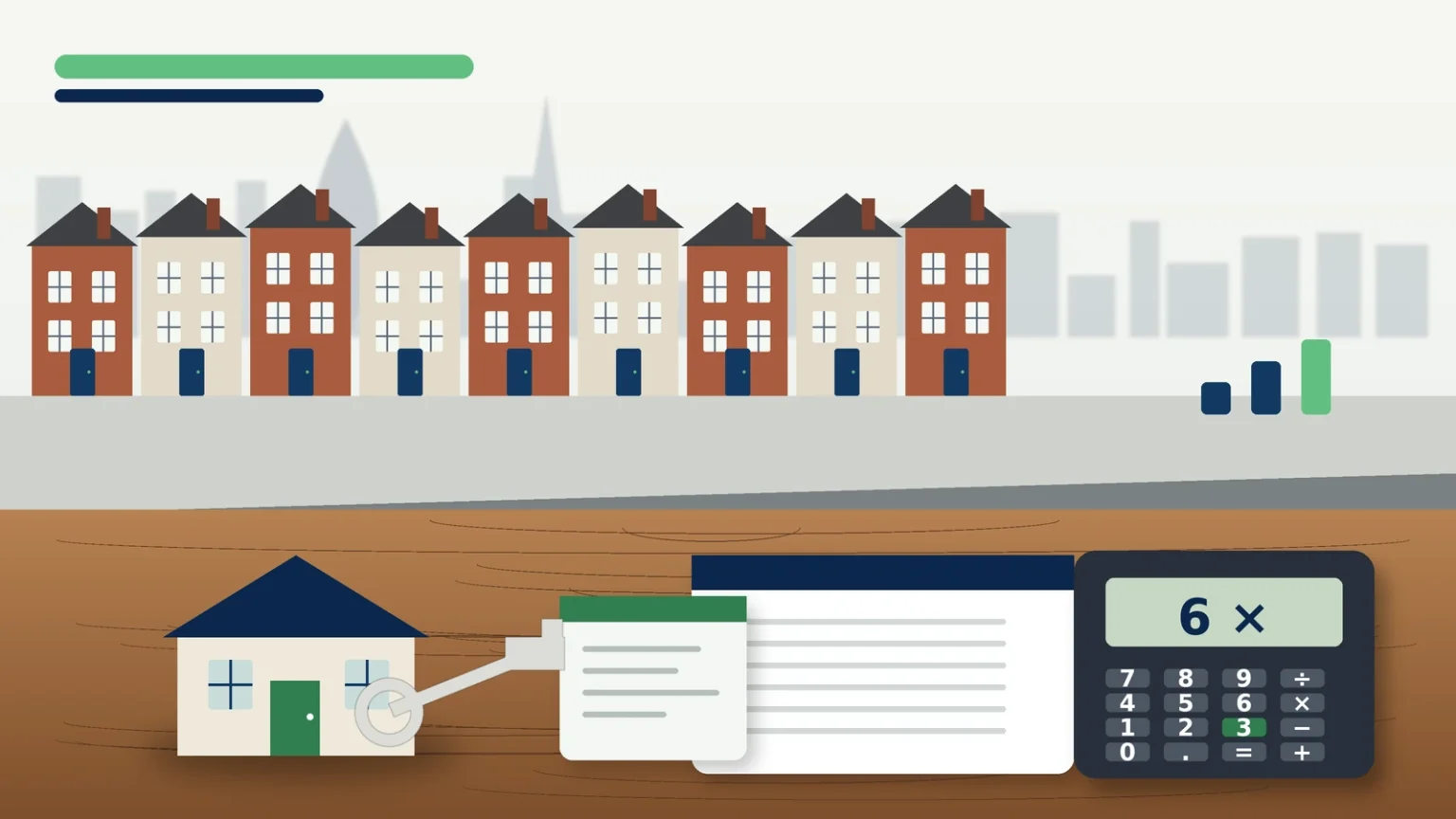
A six-times-salary mortgage is a residential mortgage where the loan may be as high as six times the income accepted by the lender.
The formal term is usually loan to income, shortened to LTI. The calculation is:
Mortgage amount ÷ accepted annual income = loan-to-income ratio
For example, a £360,000 mortgage divided by £60,000 of accepted annual income produces an LTI ratio of six.
On a joint application, the lender may use the combined income it accepts from both applicants. If one applicant earns £60,000 and the other earns £40,000, the combined accepted income could be £100,000. A theoretical six-times-income ceiling would be £600,000.
The word “salary” can be misleading because accepted income may include more than basic salary. Depending on lender criteria, it could include some or all of:
- Basic employment income
- Overtime
- Commission
- Bonuses
- Shift allowances
- Contract income
- Self-employed profit
- Salary and dividends
- Pension income
- Other regular and sustainable income
Each lender decides what income it accepts and how much of a variable component can be used.
2. Are Six-Times-Income Mortgages Available in 2026?
Yes, selected high loan-to-income options are available, but eligibility and product conditions can be narrow.
One current mainstream example is Nationwide. Its Helping Hand range allows eligible first-time buyers to borrow up to six times income on qualifying five-year or ten-year fixed mortgages. Current published criteria include at least a 5% deposit, with maximum loan-to-value depending on the fixed period. The lender's published examples use minimum income of £30,000 for a sole applicant and £50,000 jointly.
Nationwide also announced in January 2026 that eligible new customers moving home or remortgaging could borrow up to six times income at up to 95% loan-to-value. It stated minimum annual income of £75,000 for a sole new applicant and £100,000 for joint new applicants under that enhanced borrowing route.
These figures are examples of one lender's current published criteria, not a recommendation. Mortgage criteria can change without notice, and other lenders use different income thresholds, maximum multiples, loan sizes, fixed periods and property restrictions.
Official sources: Nationwide Helping Hand criteria and Nationwide's January 2026 high-LTI announcement.
3. Why Are Lenders Able to Offer More Than 4.5 Times Income?
The regulatory framework has historically treated residential mortgages at or above 4.5 times income as high-LTI lending and limited how much of this business large lenders could complete.
Interim regulatory measures and a 2026 PRA and FCA consultation have allowed or proposed greater flexibility for individual lenders, while retaining an aim that high-LTI lending should remain consistent with an aggregate market limit.
This does not create a right to borrow at six times income. Lenders must still manage credit risk, apply responsible-lending requirements and decide how much high-LTI capacity they are prepared to use.
The Bank of England's 2026 cost-benefit analysis found that high-LTI lending has been concentrated in Central and Greater London and the South East. This reflects the stronger borrowing pressure in higher-priced housing markets.
Read the Bank of England high loan-to-income consultation.
4. Income Multiple Versus Mortgage Affordability
The income multiple creates a possible ceiling. Affordability determines whether the lender is prepared to lend up to that ceiling.
A household earning £100,000 may have a theoretical limit of £600,000 at six times income. The actual result could be £600,000, £500,000, £400,000 or less, depending on the full application.
Affordability can be reduced by:
- Loans, credit cards and overdrafts
- Car finance and lease payments
- Student loan deductions
- Childcare and school fees
- Maintenance payments
- Dependants
- A shorter mortgage term
- Variable or uncertain income
- A small deposit
- Higher interest-rate assumptions
- Ground rent, service charges or estate charges
- Other properties or financial commitments
The lender may also apply a lower maximum LTI to particular loan-to-value bands, property types, mortgage terms or income profiles.
Need More Borrowing Than a Standard Income Multiple?
We can assess your income, deposit and commitments before you make an offer on a property.
5. Who May Qualify for a Six-Times-Income Mortgage?
Eligibility varies considerably. A high income multiple mortgage may be available only where the applicant meets specific product and affordability criteria. Applicants most likely to be considered often have a combination of:
- Stable and well-evidenced income
- Income above the lender's product threshold
- A clean or acceptable recent credit history
- Manageable unsecured debt
- A suitable deposit or level of equity
- A mortgage term that keeps payments affordable
- A standard, mortgageable property
- Enough monthly disposable income after essential expenditure
Some lenders reserve their highest income multiples for certain occupations, income levels, fixed-rate periods or customer types. A lender may offer six times income to a first-time buyer but use a lower limit for a home mover, or vice versa.
A headline maximum should therefore be checked against the complete product and underwriting criteria before a property offer is made.
6. What Do Lenders Check Before Offering Six Times Income?
Income and employment
The lender will check how much income can be evidenced and whether it appears sustainable. An employee may need recent payslips, a P60 and bank statements. Variable pay may require a longer history.
Credit commitments
Monthly payments on loans, cards and finance agreements reduce disposable income. A modest balance can still have a meaningful effect where the contractual monthly payment is high.
Household expenditure
Lenders use declared expenditure, credit-reference information, bank statements and statistical assumptions. Childcare and other fixed commitments can materially reduce the result.
Deposit and loan-to-value
Loan-to-value compares the mortgage with the property value. Some high-LTI products may be available with a 5% or 10% deposit, but a larger deposit can improve the product range and reduce monthly payments.
Mortgage term and age
A longer term usually reduces the scheduled monthly payment, but it can increase the total interest paid. The lender will also consider the applicants' ages and expected income through the proposed term.
Interest-rate stress and product choice
The lender must be satisfied that the mortgage remains affordable under its assessment. A longer fixed period may be required by a particular high-LTI product.
Property
The property must provide acceptable security. Non-standard construction, short leases, high service charges, unusual flats and certain new-build properties may be subject to additional restrictions.
7. How Much Mortgage Can I Borrow at Six Times My Salary?
A 6 times income mortgage can provide considerably more borrowing than a standard 4.5-times calculation, but the figures below are only income-multiple illustrations. They do not include affordability checks, product limits or lender criteria.
| Accepted household income | 4.5 times income | 5.5 times income | 6 times income |
|---|---|---|---|
| £40,000 | £180,000 | £220,000 | £240,000 |
| £60,000 | £270,000 | £330,000 | £360,000 |
| £80,000 | £360,000 | £440,000 | £480,000 |
| £100,000 | £450,000 | £550,000 | £600,000 |
| £150,000 | £675,000 | £825,000 | £900,000 |
The difference between 4.5 and six times a £100,000 income is £150,000. That can materially change the properties within budget, but it also creates a larger monthly and long-term financial commitment.
8. Can Self-Employed Applicants Borrow Six Times Income?
Self-employment does not automatically prevent an applicant from being considered for a high income multiple, but lender and product restrictions are important.
For example, Nationwide's current Helping Hand criteria state that self-employed applicants are not eligible for that particular first-time buyer product. This is a product-specific rule rather than a statement that every high-LTI lender excludes self-employed applicants.
A lender considering a self-employed application may assess:
- Sole-trader net profit
- Salary and dividends
- Salary and a share of company profit
- Contract or day-rate income
- Recent and average earnings
- Business stability and current trading
A high multiple is more difficult to assess where income has fallen, varies substantially or cannot be evidenced consistently.
Read our self-employed mortgage guidance and limited company director mortgage guide.
Helpful mortgage pages:
Unsure What Income a Lender Will Accept?
Let us check salary, commission, bonus, contract or self-employed income against current lender criteria.
9. Six-Times-Income Mortgages in London and the South East
Higher income multiples are particularly relevant in London and the South East because property prices remain high relative to earnings.
The Bank of England's 2026 analysis found that Central and Greater London and the South East together accounted for a large share of high-LTI mortgage lending. Nationwide's January 2026 affordability report also described London as the least affordable UK region by a significant margin.
A higher multiple can help close part of the gap between income and property price, but it does not solve the deposit or monthly-payment problem automatically.
A six-times-salary mortgage in London may provide more borrowing capacity, but higher property prices, deposits and monthly repayments can still limit affordability.
A buyer considering a £600,000 property with a 10% deposit needs a £540,000 mortgage. At six times income, the household would need at least £90,000 of accepted income before the lender applies the wider affordability test.
The buyer must also allow for:
- Stamp Duty Land Tax where applicable
- Solicitor and conveyancing costs
- Survey and valuation costs
- Mortgage and broker fees where applicable
- Service charges and ground rent for leasehold property
- Moving, furnishing and repair costs
- An emergency savings reserve
Use our mortgage calculator to compare possible repayments and read our guide to buying in North East London and West Essex.
10. What Could a Larger Mortgage Cost Each Month?
The table below shows approximate capital-and-interest repayments on a £600,000 repayment mortgage over 30 years.
| Interest rate | Approximate monthly repayment |
|---|---|
| 4.5% | £3,040 |
| 5.0% | £3,221 |
| 5.5% | £3,407 |
| 6.0% | £3,597 |
A one-percentage-point increase from 4.5% to 5.5% adds roughly £367 a month in this example.
These are illustrations only. They exclude product fees, assume the rate remains unchanged for the calculation and do not represent a mortgage offer.
11. What Are the Risks of Borrowing Six Times Income?
Less room for unexpected costs
A larger mortgage can consume more disposable income, leaving less capacity for repairs, childcare changes, energy costs or periods of lower income.
Greater exposure to interest-rate changes
When a fixed deal ends, the remaining balance may still be substantial. A higher future rate can produce a much larger monthly increase on a bigger loan.
Longer mortgage terms
Some borrowers use a longer term to make the payment affordable. This can reduce the monthly payment but increase total interest and extend borrowing towards retirement.
Reduced flexibility
A large mortgage can make it harder to reduce working hours, change career, start a business or absorb parental leave.
Property-price risk
A small deposit and high borrowing can leave limited equity if property values fall. This may restrict future remortgage options.
Product restrictions
High-LTI products may require a longer fixed period or carry early repayment charges. This matters if you expect to move or repay the mortgage early.
12. 5.5 Times Salary Mortgage vs Six Times Income
A 5.5 times salary mortgage may already provide enough borrowing for the intended purchase. A higher maximum is useful only when the additional borrowing is needed, affordable and suitable.
A household earning £100,000 may have theoretical ceilings of:
- £450,000 at 4.5 times income
- £550,000 at 5.5 times income
- £600,000 at six times income
If the required mortgage is £520,000, a suitable 5.5-times product may be enough. There may be no benefit in targeting a six-times product if it produces a longer fixed period, higher total cost or less flexibility.
The objective should be to secure an affordable mortgage that supports the purchase, not to reach the highest possible multiple.
13. Can Joint Applicants Borrow Six Times Their Combined Income?
Some products calculate the maximum using combined accepted income, but both applicants must satisfy the criteria.
The lender will review each applicant's:
- Income and employment
- Credit history
- Existing commitments
- Age and proposed term
- Residency status
- Property ownership history
One applicant's debts or credit history can reduce the joint borrowing figure even where the combined income meets the product threshold.
14. Can Home Movers and Remortgagers Borrow Six Times Income?
Selected options can be available to home movers and remortgagers as well as first-time buyers.
The suitability of a remortgage depends on the current balance, property value, requested additional borrowing, purpose of funds, income and remaining mortgage term.
A homeowner who does not need additional borrowing may be assessed differently from someone raising capital. Product-transfer and remortgage criteria also differ.
Visit our residential remortgage page if your current deal is ending or you want to review borrowing against your home.
Six-Times-Income Mortgage Checklist
- Confirm how much mortgage you actually need
- Separate the headline income multiple from the affordability result
- Check which parts of your income a lender may accept
- List loans, cards, finance, childcare and other regular commitments accurately
- Confirm your deposit and keep enough money aside for purchase costs
- Test the monthly payment at a higher interest rate
- Compare five-times, 5.5-times and six-times options
- Review the fixed period and early repayment charges
- Consider how parental leave, career changes or retirement could affect income
- Check whether the property meets the lender's criteria
- Obtain an Agreement in Principle before serious viewings
- Avoid making several applications without checking eligibility
Key question: would the proposed mortgage still feel manageable if your monthly costs increased or one part of the household income fell?
How a Mortgage Broker Can Help With High Income Multiples
High-LTI criteria can differ by lender, applicant type, deposit, mortgage term and income source.
A mortgage adviser can help by:
- Checking whether you need a six-times-income mortgage
- Reviewing the income a lender may accept
- Comparing lender affordability calculations
- Identifying product-specific minimum-income rules
- Checking restrictions for self-employed and variable-income applicants
- Comparing the total cost rather than only the maximum loan
- Reviewing monthly payments and stress scenarios
- Preparing the evidence before an application is submitted
Apply Mortgages supports first-time buyers, home movers, remortgagers and higher-value borrowers across London, Essex and the South East.
Frequently Asked Questions About Six-Times-Income Mortgages
Possibly. Selected lenders offer borrowing of up to six times accepted income for eligible applicants. The result depends on affordability, deposit, debts, income evidence, mortgage term, property and product criteria.
The available lenders and products change. Nationwide currently publishes six-times-income options for eligible first-time buyers and selected home movers or remortgagers, but its criteria differ by applicant type. Other lender criteria should be checked at the time of application.
There is no single market-wide minimum. Some products have specific income thresholds. The lender will also check whether the requested mortgage remains affordable after expenditure and commitments.
Some eligible first-time buyers can. Product conditions may include minimum income, deposit, fixed-rate period, employment and credit requirements.
Potentially, but lender and product restrictions vary. Some high-LTI products exclude self-employed applicants, while other lenders may assess self-employed income using accounts, tax documents, company profit or contracts.
Some products use combined accepted income. Both applicants must meet the lender's criteria, and debts or credit issues affecting either applicant can reduce the result.
Not always. Some products may be available at high loan-to-value ratios, but a larger deposit can improve the product range, reduce the loan and lower monthly repayments.
No. Six times income is a possible maximum LTI. The lender's affordability assessment can produce a lower figure after considering expenditure, debts, dependants, term and interest-rate assumptions.
Higher borrowing creates larger repayments and greater sensitivity to rate rises or income changes. The loan should be tested against your budget and longer-term plans before proceeding.
Not automatically. The right amount is the mortgage needed for the purchase that remains comfortable under realistic future costs. The lender's maximum is not a spending target.
Potentially. Higher income multiples can be particularly relevant in London because property prices are high relative to earnings. The lender will still assess income, deposit, debts, expenditure, mortgage term, credit history and the property.
Could a Six-Times-Salary Mortgage Be Suitable for You?
A six-times-income mortgage can increase borrowing capacity, but the multiple is only the starting point.
The lender must still be satisfied that the loan is affordable after considering your deposit, debts, expenditure, mortgage term, income evidence, credit profile and property.
The strongest application is not necessarily the one seeking the largest loan. It is the one where the borrowing meets the purchase objective, the payment remains manageable and the product fits the applicant's expected plans.
Apply Mortgages can compare high income multiple options and assess whether the additional borrowing is realistic before you commit to a property.
Book a free mortgage consultation to discuss your income, deposit and target purchase price.
Check Whether Six Times Income Is Realistic
Tell us your household income, deposit and target purchase price and we will explain the next practical steps.
Important information: This article was last reviewed on 7 August 2026. Mortgage products, lending criteria, income thresholds, maximum loan-to-income ratios and interest rates can change.
The lender and product examples in this article are provided for general market context and do not constitute a recommendation or guarantee of eligibility.
This article is for general information only and does not constitute personalised financial, mortgage, legal or tax advice.
Your property may be at risk and repossessed if you are not able to keep up with the repayments on your mortgage or any other debt secured on it.
There may be a fee for mortgage processing. The precise amount will depend on your circumstances and will be confirmed before you choose to proceed.
Mortgage availability and lending are subject to status, affordability, lender criteria, property acceptability and individual circumstances.