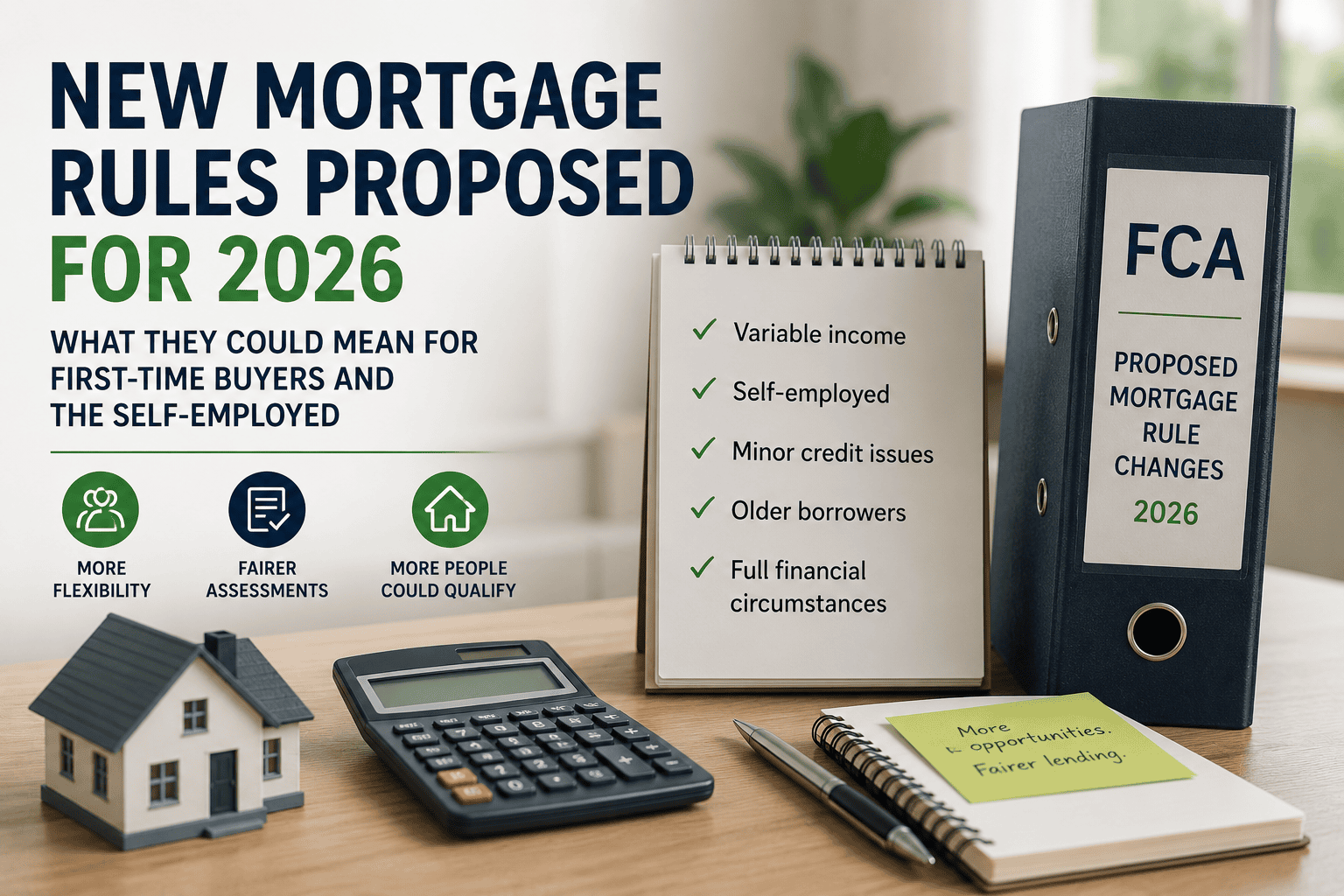
New Mortgage Rules Proposed for 2026: What They Could Mean for First-Time Buyers and the Self-Employed
The Financial Conduct Authority has proposed changes to UK mortgage rules that could give lenders more flexibility when assessing first-time buyers, self-employed applicants, people with variable income and borrowers with previous credit problems.
The proposals also cover interest-only mortgages, retirement interest-only lending, foreign-currency income and regulated bridging finance.
The consultation closed on 28 July 2026. The FCA says it expects to publish feedback and a Policy Statement during the second half of 2026. Until that process is complete, these are proposals rather than final rules.
If adopted, the changes could help some creditworthy applicants whose circumstances do not fit a standard automated mortgage assessment. They would not guarantee approval or remove the need for affordability, credit and property checks.
For advice based on your current circumstances, visit our self-employed mortgage or first-time buyer mortgage pages.
Quick guide
- The current status of the FCA proposals
- Why mortgage rules are being reviewed
- The main proposed changes
- Variable and irregular income
- What the proposals could mean for self-employed applicants
- Previous credit problems
- First-time buyers
- Interest-only mortgages
- What mortgage applicants can do now
- Frequently asked questions
The Current Status of the New Mortgage Rule Proposals
The FCA opened consultation CP26/18 on 9 June 2026 and closed it on 28 July 2026. It is now reviewing the responses and expects to publish feedback and a Policy Statement during the second half of 2026.
The proposals are not yet final rules. Lenders are not currently required to introduce the changes described in this guide.
The FCA also makes clear that responsible lending requirements would remain in place. A lender would still need to assess whether a mortgage is affordable and decide whether an applicant fits its own lending policy.
Read the FCA's official CP26/18 mortgage-rule consultation page.
Why Is the FCA Reviewing Mortgage Rules?
Mortgage lending standards became stricter after the 2008 financial crisis. These standards helped create a more resilient mortgage market, but the FCA believes that parts of the current framework may also prevent some creditworthy consumers from accessing products that suit their circumstances.
Working patterns and household finances have changed. More applicants now receive income through self-employment, contracts, commissions, bonuses, several jobs or overseas employment. More people are also seeking mortgages later in life.
The FCA wants to make targeted changes that could give lenders more room to consider individual circumstances without removing affordability checks or consumer protections.
This does not mean every lender will adopt the same approach. Many of the proposals would permit additional flexibility rather than compel lenders to accept particular applicants.
What Mortgage Rule Changes Has the FCA Proposed?
The consultation covers six main areas:
- Interest-only and part repayment, part interest-only mortgages
- Retirement interest-only mortgages
- Variable and irregular income
- Mortgages supported by foreign-currency income
- The treatment of credit-impaired applicants
- Regulated bridging loans
The areas most relevant to many first-time buyers and self-employed applicants are variable income, the evidence used for affordability, contextual treatment of previous credit issues and potential changes to interest-only lending.
1. More Flexibility for Variable and Irregular Income
Current rules do not prevent lenders from considering irregular income. In practice, however, conventional monthly affordability models may be less suitable for people whose income fluctuates during the year.
The FCA proposes replacing some references to monthly payments with regular contractual payments. This could make it clearer that a lender may agree a different regular payment frequency where the arrangement is suitable and affordable.
Applicants who could be affected include:
- Sole traders
- Limited company directors
- Freelancers and contractors
- Locums and agency workers
- Seasonal business owners
- Employees receiving substantial commission, overtime or bonuses
- People with several sources of income
The proposal would not give borrowers permission to miss payments. Any payment schedule would need to form part of the mortgage contract, and the lender would need to assess its affordability.
Lenders would also need to explain the effect of the payment structure on interest and the total cost of the mortgage.
Could the Proposed Rules Affect Your Mortgage Options?
We can review your current income, deposit and credit position without waiting for future rule changes.
2. What Could the Proposals Mean for Self-Employed Applicants?
The FCA proposes adding further examples of evidence that lenders may consider when assessing variable or irregular income. It has also referred to the potential use of account information and other data to build a fuller picture of income and expenditure.
This could be useful where an applicant has:
- Seasonal income that is stable across a full year
- Uneven monthly drawings from a business
- Regular contract renewals
- Recurring commission or bonus income
- Several separate income streams
- A recent period of self-employment supported by relevant experience
The proposals would not standardise how self-employed income is calculated.
A limited company director could still be assessed using salary and dividends by one lender, while another may consider salary and a share of company profit. A sole trader might be assessed using an average of recent years or the latest year, depending on the lender and the circumstances.
Applicants should continue preparing:
- Finalised accounts
- SA302 tax calculations and Tax Year Overviews
- Business and personal bank statements
- Current contracts
- Evidence of recurring work
- Details of salary, dividends and company profit
- Explanations for material income changes
Read our guide to self-employed mortgages with one year's accounts and our main mortgages for the self-employed page.
3. A More Contextual Approach to Previous Credit Problems
The FCA is concerned that some lenders may use its technical definition of a credit-impaired customer more broadly than intended.
Its proposals are intended to encourage lenders to consider whether an applicant's current financial circumstances and subsequent payment history justify a more individual assessment.
Factors a lender may still review include:
- The type of credit problem
- How recently it occurred
- The amount involved
- Whether it has been settled
- The reason it happened
- The applicant's conduct since the event
- Current debt and expenditure
- Deposit or equity
- The requested loan-to-value ratio
A recent default caused by continuing financial difficulty is unlikely to be treated in the same way as an old, isolated missed payment followed by a sustained period of stable conduct.
The proposed approach is about context. It does not mean lenders would ignore previous credit problems.
Helpful mortgage pages:
Self-Employed or Receiving Variable Income?
Let us check which lenders may already consider your income structure and supporting evidence.
4. What Could the Changes Mean for First-Time Buyers?
The proposals are intended partly to support sustainable access to home ownership. They may be relevant to first-time buyers who do not fit a conventional salaried profile.
This could include:
- Self-employed applicants
- Contractors and freelancers
- Applicants receiving regular overtime or commission
- Buyers with variable working hours
- Applicants with income from more than one job
- Buyers with a small or historic credit issue
- People considering part repayment and part interest-only borrowing
The proposed changes would not solve every affordability problem. Lenders would still consider income, deposit, monthly commitments, credit history, mortgage term, dependants, interest-rate changes and property acceptability.
First-time buyers should not postpone preparing for a mortgage because they expect the rules to change. Accurate documents, realistic budgeting and suitable lender selection remain important under the existing rules.
Our first-time buyer mortgage page explains how we can assess your deposit, income and buying budget.
5. Proposed Changes to Interest-Only Mortgages
The FCA is considering targeted changes to interest-only and part repayment, part interest-only mortgages.
These products have lower scheduled payments than a full repayment mortgage because some or all of the capital remains outstanding during the term. This can also mean paying more interest overall and needing a credible way to repay the remaining capital.
The FCA proposes:
- Changing when a formal repayment strategy is required
- Adding further examples of potentially credible repayment strategies
- Clarifying when lenders should review the strategy
- Changing evidential expectations where the sale of the main property is part of the strategy
The FCA is not proposing a return to pre-financial-crisis self-certification or unrestricted interest-only lending.
Interest-only borrowing would remain suitable only for particular applicants. It should not be treated as a general answer to an otherwise unaffordable mortgage.
6. Mortgages Supported by Foreign-Currency Income
The consultation proposes changes affecting sterling mortgages supported by income paid in another currency.
This could be relevant to:
- Cross-border workers
- International contractors
- Employees of overseas businesses
- Returning UK residents
- Applicants receiving part of their income from abroad
Exchange-rate movements would still affect affordability. Lenders could continue to discount foreign income, restrict accepted currencies or decline income they consider too volatile.
7. Proposed Changes for Older Borrowers
The consultation also includes retirement interest-only mortgages and other aspects of later-life lending.
The proposals could provide lenders with more discretion when considering matters such as pension income, survivor benefits, life assurance, property equity and possible later-life repayment strategies.
A lender could still decide that affordability for a surviving borrower must be demonstrated. The proposal would provide greater discretion rather than remove the risk assessment.
What Will Not Change?
Even if final rules are introduced, lenders will remain responsible for deciding who they lend to.
Applicants should expect lenders to continue checking:
- Whether income is genuine and sustainable
- Whether the proposed mortgage is affordable
- Existing debts and regular expenditure
- Credit history
- Deposit source
- Identity and address history
- Property condition and acceptability
- The effect of future interest-rate changes
- The proposed mortgage term
- The lender's own risk policy
Two applicants with similar incomes may therefore continue receiving different decisions from different lenders.
How a Mortgage Broker Can Help
The proposals highlight the importance of matching an applicant with a lender whose assessment method suits their circumstances.
A mortgage broker can help by:
- Identifying lenders that consider variable income
- Checking how company directors and sole traders are assessed
- Reviewing the treatment of bonuses, overtime and commission
- Checking criteria for previous credit events
- Explaining foreign-income restrictions
- Comparing repayment and interest-only structures where appropriate
- Reviewing documents before submission
- Reducing unnecessary mortgage applications
- Presenting relevant background to an underwriter
An applicant who is declined by one lender may still meet another lender's criteria. This does not mean every case can be placed, but lender selection can be particularly significant where income or credit circumstances are less straightforward.
Should You Wait for the New Mortgage Rules?
Most applicants should not delay a suitable purchase or remortgage solely because the FCA may introduce new rules.
The final policy may differ from the consultation. Lenders may also need time to change their systems, underwriting and product ranges after final rules are published.
What mortgage applicants can do now
- Check your credit reports for errors or undisclosed issues
- Reduce avoidable unsecured borrowing where practical
- Avoid unnecessary new credit applications
- Prepare current and consistent income evidence
- Keep business and personal finances clearly organised
- Explain significant income fluctuations
- Document the source of your deposit
- Review affordability before making property offers
- Check lender criteria before submitting an application
- Obtain an Agreement in Principle when you are ready to view seriously
Read our Agreement in Principle guide before starting serious property viewings.
Illustrative Applicant Scenarios
Seasonal self-employed applicant
A self-employed applicant receives most of their annual income during part of the year. Their yearly income is sufficient, but monthly receipts fluctuate significantly. A lender using a longer assessment period may be able to obtain a clearer view of sustainable income.
Applicant with an old credit issue
An applicant experienced missed payments following a temporary financial problem several years ago. They have since repaid the debt and maintained stable conduct. A contextual assessment may give more weight to the subsequent recovery than an automated exclusion would.
First-time buyer with commission income
A first-time buyer receives a basic salary and regular quarterly commission. A lender may assess a history of commission payments rather than relying only on the most recent payslip.
UK resident paid in another currency
A UK resident works for an overseas business and receives salary in euros while applying for a sterling mortgage. The lender would still need to consider currency movements and may apply a reduction to the income used for affordability.
These examples are illustrations only and do not represent lending decisions or guarantees of mortgage approval.
Frequently Asked Questions About the Proposed Mortgage Rules
No. The FCA consultation closed on 28 July 2026, but final rules have not yet been published. The FCA expects to publish feedback and a Policy Statement during the second half of 2026.
It may become easier for some applicants if the proposals are adopted and lenders use the additional flexibility. Approval will still depend on affordability, credit, deposit, property and lender criteria.
The proposals do not set a standard number of years of accounts. Some lenders already consider one year of accounts, while others require a longer history. The changes focus on flexible assessment and evidence.
The FCA proposes clarifying that lenders may agree other regular contractual payment frequencies where suitable. Lenders would decide whether to develop and offer such products.
No. Lenders will still assess credit history. The proposals encourage a more contextual approach where an applicant can show improved financial stability.
The proposals may support some targeted interest-only or part interest-only lending. These products would not be suitable or available for every first-time buyer.
Some lenders already consider foreign-currency income. The proposed changes may reduce certain regulatory barriers, but exchange-rate risk and lender currency restrictions would remain.
Current lender criteria may already suit your circumstances. A mortgage review can establish whether suitable options are available now rather than relying on possible future changes.
No. Lenders would retain their own risk policies and decide how to apply the FCA rules within their products and underwriting processes.
No. The FCA states that responsible lending requirements remain in place and firms must continue checking that mortgages are affordable.
Could the Proposed Rules Improve Your Mortgage Options?
The FCA proposals could give lenders more freedom to assess variable income, previous credit problems, interest-only borrowing and later-life applications.
They are not final rules, and lenders would still apply their own affordability checks and risk policies. The outcome for any applicant would depend on their current income, commitments, deposit, credit record, property and the criteria of the lender approached.
Apply Mortgages can review your current circumstances rather than asking you to wait for possible future changes. We support first-time buyers, sole traders, contractors, limited company directors and applicants with variable or more detailed income across London, Essex and the South East.
Visit our mortgage consultation page to discuss the options currently available.
Discuss Your Mortgage Circumstances
Tell us about your income, deposit, credit history and property plans and we will explain the next practical steps.
Important information: This article was last reviewed on 5 August 2026. The FCA proposals described are not final rules and may change after consultation.
This article is for general information only and does not constitute personalised financial, mortgage, legal or tax advice.
Your property may be at risk and repossessed if you are not able to keep up with the repayments on your mortgage or any other debt secured on it.
There may be a fee for mortgage processing. The precise amount will depend on your circumstances and will be confirmed before you choose to proceed.
Mortgage availability and lending are subject to status, affordability, lender criteria, property acceptability and individual circumstances.