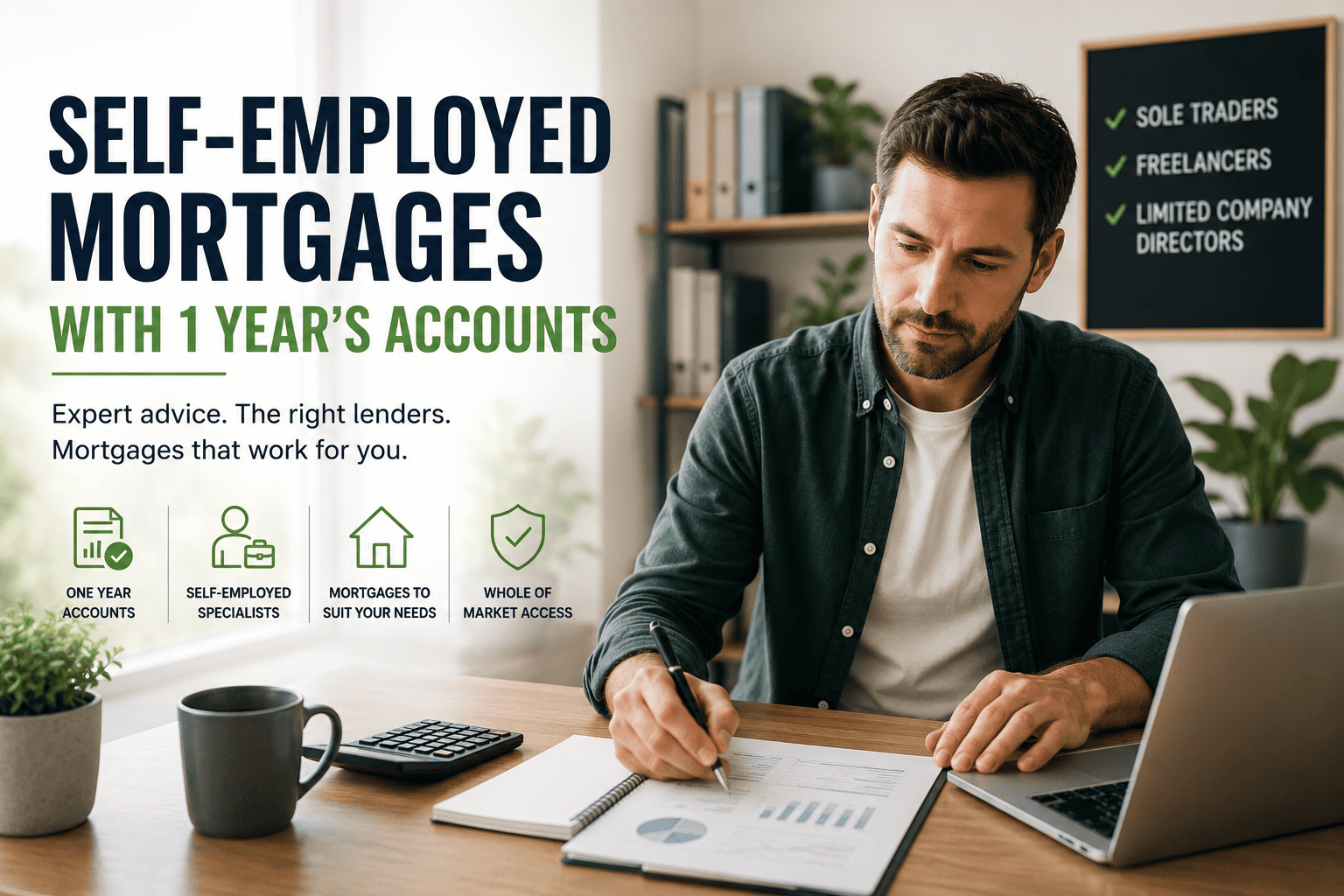
Self-Employed Mortgages: Can You Get Approved With One Year of Accounts?
Getting a mortgage when you are self-employed can feel less clear cut than it does for someone on PAYE. If you have only been trading for a year, have income that changes from month to month, or draw money through a limited company, it is easy to assume that lenders will not be interested.
That assumption can cost you time. In many cases, the question is not simply whether a mortgage is available. It is whether your income is being assessed by the right lender, using the right criteria, with the right documents in place.
This guide explains how self-employed mortgages work, how lenders assess income, what can happen with one year of accounts and how to prepare before applying. Apply Mortgages helps self-employed applicants across London, Essex and the South East, including sole traders, freelancers and limited company directors.
Quick guide
- Can self-employed applicants get a mortgage?
- Can you get approved with one year of accounts?
- How lenders assess self-employed income
- Documents you may need
- Sole trader mortgage applications
- Limited company director mortgage applications
- Why self-employed applications get declined
- Use the preparation checklist
- Read the frequently asked questions
1. Can You Get a Mortgage If You Are Self-Employed?
Yes, self-employed applicants can get mortgages, subject to lender criteria, affordability, credit history and the property being suitable security for the loan.
A self-employed mortgage is usually not a separate product. Most applicants are applying for a standard residential mortgage. The difference is how the lender reviews income and checks whether that income is sustainable.
Lenders may look at:
- How long you have been trading
- Your latest declared income
- Previous years of income, where available
- Your business structure
- Your deposit and loan-to-value
- Personal and business bank statements
- Existing credit commitments
- Your credit history
Being self-employed does not automatically make you a higher risk. The challenge is often proving your income in the way a suitable lender expects to see it.
2. Does One Year of Accounts Mean You Cannot Get a Mortgage?
No. One year of accounts does not automatically mean no.
Many lenders prefer two years of trading history, and some may ask for three. That does not mean every lender takes the same approach. Some lenders may consider an applicant with one full year of accounts or one completed tax return, provided the rest of the case is strong enough.
Factors that can help include:
- A clean credit record
- A suitable deposit
- Low personal debt
- Evidence that the business is trading well
- Previous experience in the same industry
- Clear bank statements
- Accounts or tax documents that match the income being used
With one year of accounts, lender choice is usually narrower. This is where advice becomes particularly useful. A declined application can sometimes mean the wrong lender was approached, not that a mortgage is impossible.
3. How Lenders Assess Self-Employed Income
Different lenders use different income calculations. That is one of the main reasons self-employed applicants can receive conflicting answers.
For sole traders, lenders usually focus on net profit rather than turnover. A business may have strong turnover, but the figure that matters for affordability is usually what remains after allowable expenses.
For limited company directors, some lenders use salary and dividends. Others may consider salary plus a share of company net profit, depending on their criteria and the applicant’s shareholding.
For freelancers and contractors, the lender may want to see whether work is regular, how income is evidenced and whether the pattern appears sustainable.
Some lenders average income over two years. Others may use the latest year, the lower year, or a different approach depending on the figures. This means lender selection can have a significant effect on the outcome.
4. What Documents Do Self-Employed Mortgage Applicants Need?
The exact documents depend on the lender and your circumstances, but self-employed applicants may be asked for:
- SA302 tax calculations
- Tax Year Overviews
- Full business accounts
- Personal bank statements
- Business bank statements
- Proof of deposit
- Proof of identity and address
- Details of credit commitments
- Accountant’s details, where relevant
If you run a limited company, the lender may also review company accounts, salary, dividends, retained profit and your shareholding.
Preparing these documents early can reduce delays and make it easier to identify lenders that fit your position before an application is submitted.
Self-Employed and Unsure What You Can Borrow?
Speak to Apply Mortgages before choosing a lender or submitting an application.
5. Sole Traders: Net Profit Matters More Than Turnover
If you are a sole trader, lenders will usually look at the net profit declared through your tax return.
Turnover can be useful background, but it is not normally the income figure used for mortgage affordability. A sole trader with high turnover and low declared profit may find their borrowing lower than expected.
Before applying, it helps to review:
- Your latest tax calculation
- Your Tax Year Overview
- How your net profit has changed year by year
- Whether large one-off expenses affected the figures
- How much deposit you have available
If the latest year is stronger than previous years, some lenders may be more flexible than others. If income has fallen, the lender may ask for a clear explanation.
6. Limited Company Directors: Salary, Dividends and Company Profit
Limited company directors are often assessed differently from sole traders.
Some lenders use salary and dividends only. This can be restrictive if you take a modest salary, draw limited dividends and leave profit in the business. Other lenders may consider salary plus a share of net profit, but this depends on their criteria.
A lender may consider:
- Your salary
- Dividend income
- Your shareholding in the company
- Company profits
- Retained profit
- Business bank statements
- The most recent accounts
This is a common reason company directors speak to a mortgage broker. The right lender can make a material difference to how much income is recognised for affordability.
7. Freelancers and Contractors: Proving Sustainable Income
Freelancers and contractors can be assessed in more than one way, depending on how they are paid and how their income is recorded.
Some applicants have regular contracts. Others have several clients, variable monthly income or gaps between projects. A lender may ask for tax documents, accounts, contracts, invoices or bank statements to understand the income pattern.
Helpful evidence may include:
- Current contracts
- Recent invoices
- Bank statements showing regular income
- Tax documents showing declared earnings
- Evidence of previous work in the same field
The aim is to show that the income is not only present, but likely to continue at a level that supports the mortgage.
Only Have One Year of Accounts?
Do not rule yourself out without checking which lenders may consider your case.
8. Why Self-Employed Mortgage Applications Get Declined
Self-employed applications can be declined for many reasons. A decline does not always mean you cannot get a mortgage, but it should be reviewed carefully before another application is made.
Common issues include:
- Not enough trading history for the lender selected
- Net profit being lower than expected
- Income falling in the latest year
- Bank statements showing returned payments or heavy credit use
- Credit commitments affecting affordability
- Tax documents not matching the income declared
- Complex company director income
- The property not meeting lender criteria
If one lender says no, it does not mean every lender will take the same view. The next step should be to understand exactly why the application failed.
9. How to Improve Your Chances Before Applying
Preparation can make a real difference, especially when the case is more specialist.
Before applying for a self-employed mortgage, consider the following:
- Make sure your tax returns are up to date
- Download your SA302s and Tax Year Overviews
- Keep business and personal finances easy to understand
- Check your credit file for mistakes
- Avoid taking on unnecessary new credit
- Reduce overdraft use where possible
- Prepare bank statements in advance
- Keep evidence of your deposit
- Speak to an adviser before submitting lender applications
If you plan to apply in the near future, it can also be sensible to speak with both your accountant and your mortgage adviser. Tax planning and mortgage affordability do not always pull in the same direction.
10. Do Self-Employed Applicants Pay Higher Mortgage Rates?
Not automatically.
If you meet a lender’s criteria and your application fits standard affordability checks, you may be able to access the same type of mortgage products as employed applicants. Rates are more often affected by loan-to-value, credit profile, product type, property type and the lender selected.
Costs can increase where a specialist lender is needed, for example where there is limited trading history, adverse credit or complex income. Even then, the right approach is to compare suitable options rather than assume the first answer is the only answer.
11. Why Apply Mortgages for Self-Employed Mortgage Advice?
Apply Mortgages helps self-employed applicants understand what may be possible before they commit to a lender application.
We can review your income structure, documents, deposit and credit position before recommending a suitable route. This is particularly useful if you have one year of accounts, company director income, retained company profit, variable income or previous credit issues.
We support clients in London, Essex and across the South East, but the advice is based on your circumstances rather than your postcode.
You can also read our dedicated mortgages for the self-employed service page for more information about how we help.
Self-Employed Mortgage Preparation Checklist
- Confirm how long you have been trading
- Gather your latest accounts or tax return documents
- Download your SA302s and Tax Year Overviews
- Prepare recent personal and business bank statements
- Check whether your income is rising, falling or inconsistent
- Review your credit file before applying
- Keep proof of deposit ready
- Avoid new borrowing where possible before the application
- Speak to an adviser before approaching several lenders
Thinking of applying soon? A short review before you submit an application can help identify the lenders most likely to understand your income position.
Frequently Asked Questions About Self-Employed Mortgages
Yes, subject to lender criteria, affordability, credit history and the property being acceptable to the lender. Self-employed applicants are usually assessed on income evidence rather than payslips.
It may be possible. Some lenders may consider one full year of accounts or one completed tax return, although your lender choice is likely to be more limited.
Many lenders prefer two years of accounts. Some may ask for three, while others may consider one year if the rest of the application is strong.
Lenders usually focus on net profit rather than turnover. They want to understand the income available after allowable business expenses.
Some lenders assess salary and dividends. Others may consider salary plus a share of company profit, depending on their criteria and your shareholding.
Self-employed applicants are often asked for SA302 tax calculations and Tax Year Overviews as evidence of declared income.
Not necessarily. If your application meets standard lender criteria, you may be able to access the same type of products as employed applicants.
Yes, but the lender will assess your current income evidence, affordability and trading history. It is worth checking your options before your current deal ends.
A drop in income does not automatically mean a mortgage is unavailable, but the lender may take a more cautious view and ask for an explanation.
It can with some lenders, but not all. Some lenders focus on salary and dividends only, while others may consider company profit where their criteria allow it.
Yes. This is particularly useful if you have one year of accounts, company director income, variable earnings or previous credit issues.
Find out why the application was declined before applying elsewhere. Another lender may take a different view, but the reason for the decline should be reviewed first.
Do Not Assume You Will Not Qualify
Being self-employed can make a mortgage application more detailed, but it does not automatically make it unworkable. One year of accounts, variable income or a limited company structure may narrow the lender options, but they do not always close the door.
The most useful step is to review the income evidence before applying. That helps identify which lenders are more likely to assess your income in a way that fits your circumstances.
Apply Mortgages can help you understand your options, prepare the right documents and approach suitable lenders based on your position.
Need Self-Employed Mortgage Advice?
Tell us how you earn and we will explain the next steps clearly.
Important information: This article is for general information only and does not constitute personalised financial advice.
Your property may be at risk and repossessed if you are not able to keep up with the repayments on your mortgage or any other debt secured on it.
There may be a fee for mortgage processing. The precise amount will depend on your circumstances and will be confirmed before you choose to proceed.
Mortgage approval is subject to status, affordability, lender criteria and individual circumstances.